Thursday, 6 February 2014

Music of Late

I haven't posted anything musical of late, so I'll just quickly mention a few things I've been listening to recently. My brother recently asked me about suggestions for four-four dance music (for example: house, techno, etc.), which reminded me of a mix I've enjoyed over the past months by a chap called Pearsall. This prompted me to visit his website, of which the URL was listed on my MP3 player, at www.sonicrampage.org. Apart from having a name fabulously evocative of pounding bass, Pearsall provides us with a bewildering array of different mainly dance music mixes, from drum and bass, to techno, to house, to trance and many other genres in between. Each mix is completely free and is accompanied by a post about what prompted him to make that mix, it's a highly entertaining website with plenty of good quality mixes, although beware of the olfactory presence of a particular French dairy product in some of his musical tapestries.

I've been having a bit of a renaissance of hip-hop enjoyment of late. In particular I've been listening to a mix by DJ Moocha, also known to me for excellent selections of jungle, this mix includes many fine examples of UK and US hip-hop, mainly harking from the late nineties onward. Some of my favourite raw producers are on there, from Rodney P and Jehst to Wu Tang Killa Bees and various classics that I know from nights out in London but whose names escape me. Jehst is an English artist, who does a lot to dispel the image of hip-hop as all about gold and misogyny with his lyrics about all manner of topics including, oddly, Charles Bukowski in "Alcoholic Author". I'd suggest listening to "High Planes Drifter", an EP that has many of my favourites on, a great showcase of Jehst's lyrical poetry and commentary on urban life in the UK. Rodney P is somewhat rowdier, one for a party mood, I've been listening to "The Future" of late, his debut album that has some heavily produced tracks on it, often tinged with reggae or dancehall influences.

For DJ Moocha have a look at https://www.mixcloud.com/tag/dj-moocha/ or http://www.illfm.net/browse/show/7/1.html , the latter is my old favourite, the Ill FM internet radio station site.

Jehst - "Alcoholic Author"

Some of Rodney P's Caribbean influenced hip-hop sound.

Something recently reminded me that I also wanted to listen to Fela Kuti, the famous pioneer of Afrobeat music from Nigeria and political activist, most prominent during the 1970's. It is to this soundtrack accompanied by the patter of oriental rain that I type. I can report that his music is very listenable indeed, I'm really enjoying "Shakara - The London Scene", it's very brassy soul-tinged music, with an unmistakably gravelly voice providing a commentary in what is presumably Nigerian language. I heartily recommend giving Fela a listen.

"Shakara" by Fela Kuti, described here as iconoclastic (!).

Thanks for reading.  

Tuesday, 21 January 2014

Tea Eggs 茶蛋

Another breakfast follow up

                                                   During my post about Chinese breakfast, I completely neglected to mention that typical Chinese food the tea egg. Needless to say, alongside the mantous, baozis and paper cups of fresh dou jiang sits a steaming, sometimes bubbling, always brown and mysterious rice cooker full of eggs. They sit wrapped in their shells in a dark brown liquid, dyed as such by a mixture of herbs and spices and left all day to simmer or just to be kept at a warm temperature. They do not look especially appetizing, but they are a quite flavourful and a good way to either supplement your mantou or give you a little snack during the day. Under their shells the flesh is dyed a soft brown colour, akin to a milky cup of instant coffee. When bitten into the flavour is fairly salty, with a hint of that pervasive Chinese spice flavour, a hint of aniseed and various other tastes too numerous to pick out. They are eaten as breakfast items or as snacks, which are known as 小吃, which literally translates as “little eats”, another pleasing linguistic titbit from this endlessly entertaining language.  

Tuesday, 14 January 2014

Israeli Breakfast

This is just a quick follow up to my previous post about Chinese breakfast. After reading said post a friend of the family emailed me with this delightful example of Israeli breakfast. 

"The whole breakfast bit made me think of my jaundiced attitude to big breakfasts, but if it is what you like, you should know that Israel has a tradition of enormous breakfasts. Perhaps it's the legacy of British rule, the influence of Arab hospitality, and the impact of Jewish maternal guilt. Not sure why, but a regular breakfast at a decent hotel will include:

6-7 kinds of yogurt, labneh, cottage cheese
gigantic fruit plates
enormous dried fruit plates (figs, raisins, dates, apricots, etc.)
eggs in every form
sweets, pastries, halvah, danish, bagels
hummous, babaganoush, matbucha
fried vegetables (cauliflower, eggplant, mushrooms)
waffles, pancakes
jams
coffee, tea, espresso"

Thanks for that, Nancy. This is now on my must-try list, I'll be wearing the fat pants for this one. I didn't even know there were 6-7 kinds of yoghurt. 

Just a quick explanation of some of the less well known things: halvah is a sweet, fairly hard cake of which there are two kinds. My favourite is the one made of nut butter and has pistachio nuts embedded in it, the other sort is made of flour. Babaganoush, also known as poor man's caviar by some people, is a paste made of barbecued aubergine (eggplant), where the skin has been peeled from it and the innards have been mashed into a pulp. This dish fully deserves its name, it tastes rather smokey and is absolutely delicious. Labneh is a yoghurt from which the whey has been strained, leaving behind something like cottage cheese. I had to look up matbucha, but Wikipedia.org easily provided answers. According to Wikipedia it's "a cooked dish of tomatoes and roasted bell peppers seasoned with garlic and chili pepper". It sounds pretty good, I think I'll have to try this enormous repast at some point.    

Monday, 6 January 2014

Chinese Breakfast

                                Before I start let me just apologise for not blogging for so long. I’ve been quite busy looking to the future and what I’ll do in China and abroad after finishing my contract here and rather forgotten about my love of blathering on about food and music. I’ve still been listening to a lot of music and eating a lot of food, however, a fact which should surprise no one. I wished to write this post some time ago, but I’ll do so now instead by way of slowly easing myself in again. Hopefully I’ll be somewhat more regular with my narrative ramblings from here on in, next on the medium term agenda is a multi-post retelling of my attempts to munch my way through Chengdu (rest assured Panda steaks will not be making an appearance, for anyone with entirely reasonable concerns about my adventurous eating habits). In any case, as so often is the case I digress from the business at hand.

                                Britain has a somewhat historically shaky reputation when it comes to cuisine, displaying such crimes against cooking as luncheon meat (bizarrely easy to get in any Chinese corner shop), fried bread and devilled kidneys. However, Britain can be said to have held its own in one key area, that of breakfast. The everyday is unremarkable, the ubiquitous bowl of cereal or piece of toast ever present, but Britain really shines when it comes to the big breakfast, a plate of which will typically have enough calories to feed an entire rowing team after a starvation diet (say, in the region of 100,000 calories). I exaggerate to make a point, but I feel the point is well made, for more on this see my earlier post about the delights of English breakfasts. Having grown up in England and being a self-confessed glutton I have rather high expectations, or at least highly calorific, when it comes to a proper breakfast. I feel the only nation that comes really close to Britain when producing spectacular breakfasts is the USA[1], but I like to keep an open mind and I certainly found it necessary to find out about the morning consumption habits of the great Middle Kingdom, in fact on some days as a matter of gastric exigency (or because I’m bloody starving, if you prefer).

                                I wasn’t particularly confident about Chinese morning food, which is the exact name of breakfast in Chinese (zao fan – 早饭). I’d heard all kinds of horrific tales about far eastern morning habits, involving mostly cold noodles and fried rice. It is with great pleasure that your gluttonous correspondent in China can report that, while English breakfast it isn’t, there are plenty of tasty morsels to be had when you get up in this country. The first rather curious thing is the lack of a standard caffeinated beverage in the morning, this is particularly surprising given the national tendency to get up at stupid o’clock and do things like blow up artillery outside my bedroom window, though perhaps this stands in to give them that much needed kick in the morning. Many people have of course picked up western norms and drink coffee or red tea 红茶 (what they call black tea here, more on this in the future) in the morning, but the local hot beverage seems largely to be hot soy milk, or dou jiang 豆浆 . I can’t quite bring myself to be so culturally genuine as to give up my non-explosive cup of kick in the morning, but I do sometimes buy a cup of this as well on my way to work, as it is quite delicious and fairly filling. When I do buy this it’s generally from the baozi 包子 (roughly pronounced bow-zer) shop outside my apartment block. I buy it here because they make it fresh, a delightful and cheap beverage (usually the equivalent of about 20p) that’s available in many places here. All it involved is a spoonful of sugar, some soy beans and a cup full of hot water made into a thick and nourishing liquid in a blender, much nicer than all the unpleasantly thin milk alternatives available in the west.
                               
                         “What is a baozi shop?”, you may well ask. Baozi are steamed buns filled with a large variety of possible fillings, from the most common minced pork (zhu rou – 猪肉[2]) filling, to red bean paste, to vegetable and even rice noodle fillings, among many others. I even heard someone suggest the one could fill one with an English breakfast, perhaps this would be a super-sized baozi, if anyone with the culinary nous out their wants to have a go please do, then invite me round to give it a taste test and my infinite admiration. Since I’m often on the run in the early hours when buying things from hear I usually opt for a sweet mantou 馒头 , a somewhat simpler and more digestively forgiving roll of sweet steamed bread. This, coupled with a cup of hot soy milk is a lot more filling than you’d realise. This offering is my breakfast-on-the-run option here.

One of my local breakfast stalls. The reason for the haze is the intense heat and humidity during the summer in Suzhou.

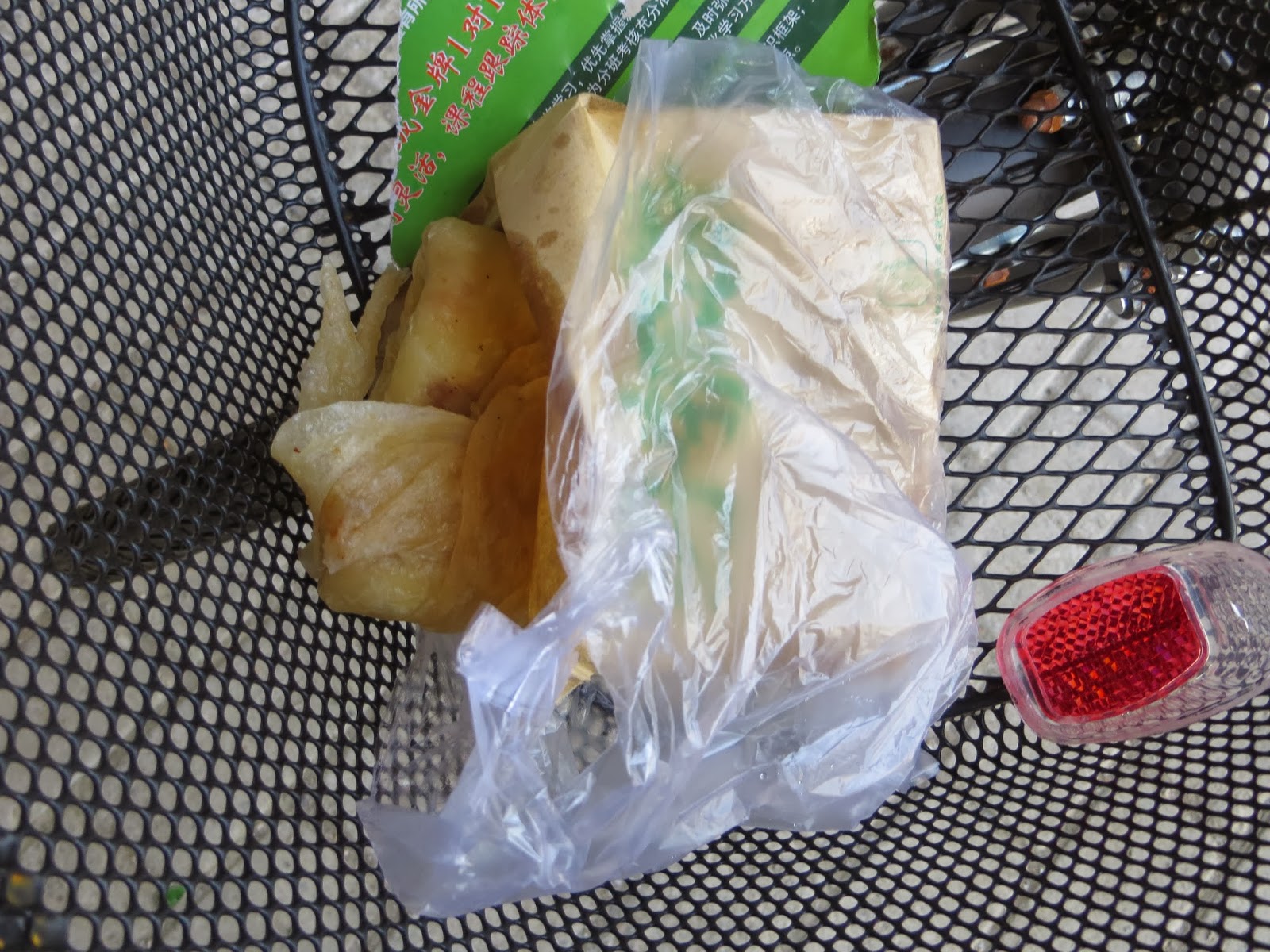
                                Coming to China I was quite excited by the availability of street food, this is largely represented by shaokao 烧烤, the common late night Chinese barbecue. However, what’s been a pleasant surprise is the perpetual morning presence of the bingzi 饼子 stand. Bingzi are basically pancakes, the Taiwanese variety are very popular, being quite thick and usually served with at least an egg wrapped inside. Other popular accompaniments include lettuce (don’t worry, they fry it slightly first to make sure no pesky health benefits abide), Taiwanese sausage, bacon and, on certain fortuitous occasions, cheese. There are also thinner crepe like alternatives available, usually served with a fried dough stick, some lettuce (again, making sure all vitamins are killed in the medieval fashion of boiling in oil) and various other choices such as meat and chilli or even a sweet bean paste. I most often eat pancakes either on days when I have more digestion time or when I’m setting off on a long journey, since they are pretty effective at keeping hunger at bay.

All the blondies enjoying bingzi.
                                
                           Now I wish to tell you about a couple of breakfasts I've had in this wonderfully gastronomic country. One of my happiest memories of breakfast in China was when my mother, father and nephew visited at the beginning of summer. We were staying on an island known as PutuoShan, just off the coast of Zhejiang province in the East China Sea. It’s famous for its shrines to Guanyin, a person of historical note within east Asian Buddhism; it’s an island imbued with much religious significance, a particularly touching cultural experience in the context of a regime that actively crushed organised religion not so long ago. Touching as it was, nothing could distract us from the urgent need for the first meal. We found a restaurant that served breakfast a short walk from our accommodation, and I was rather excited by the provision of apparently almost every normal Chinese breakfast choice with some extras. There were the usual baozis and mantous, but there was also the purple sloppy red bean porridge, a rather unpleasantly bland concoction. There was also something called dou hua, which seemed to be a curd made of soy and came topped with dried shrimps. This probably sounds horrible, and no doubt to some people it is, but I rather liked the cold curd and salty tickle of the dried shrimp, a pleasant sensation in the blazingly hot Chinese summer. They also had fried dumplings, which are a favourite breakfast of the Chinese, something perhaps surprising to westerners. One thing remained certain, we would not be hungry for some time after this feast.

Breakfast with my family on Putuoshan.

                                Another experience consigned to the romanticised history section of my psyche is that of breakfast in Shanghai. When Celia (my partner) and I go to Shanghai we always stay in a hostel called Shanghai City Central Youth Hostel, partly because it’s very cheap but basically as good as a value hotel in England, partly because of their delicious and cheap cocktails, and partly because they used to have wonderful breakfasts. The fact that they are now defunct probably adds to the romanticising, but they were definitely delicious. Piles of steaming baozis, hot soy milk and even some horrible red bean porridge if you were feeling masochistic. My favourite thing to do was take a fried dough stick and soak it in hot soy milk. These dough sticks are call youtiao 油条 and are a little oily and salty, in my opinion they taste best when used as a sort of giant crouton in soy milk or soups. They can be eaten at any time of day and are also one of my favourite additions to a hot bowl of malatang. As I mentioned earlier the breakfast is now defunct, something I discovered to my sadness last time I stayed there, probably because it wasn’t profitable given that it was included in the price of a stay. Luckily, it’s in the middle of Shanghai, so there’s enough food to feed a small army on every corner.

                                So, in conclusion Chinese breakfast certainly holds its own. It will never compare to British breakfast, but I’m not sure that anything ever will for me. There are certainly a plethora of wonderful breakfast options for the hungry early riser in the Middle Kingdom.

 More pictures of Mr. Bingzi.

 The competition.

A slice of China: bicycles and bingzi.

                                 I meant this to be a short post, but I seem to have gotten somewhat carried away again, yet another testament to one of China’s greatest cultural assets: its cuisine. Thanks for reading.    


[1] For a wider discussion of breakfasts around the world see The Breakfast Bible by Seb Emina and Malcolm Eggs.
[2] I like the second character, meaning meat, it looks rather like a rack of ribs, don’t you think?

Tuesday, 15 October 2013

Dongshan – Dragon Prawns and Tea

东山 – 龙虾和茶


                                Summer has been pretty tough here – Suzhou: hot, humid and a lot of work. Recently I returned to having two days off and the temperature dipped to something slightly more reasonable, although the air remains stubbornly close. Given this somewhat more clement state of affairs Celia and I decided to head to Dongshan 东山on our days off. For me, this was mainly a way to scratch a culinary itch I had; my friend Jason, a Suzhou native, had to my great interest informed me that Tai Hu 太湖, a huge lake local to Suzhou, was the farming place of many fisherman who cultivated and caught crayfish as part of their fishing staple. This particularly interested me because I’m half Swedish, which may initially appear to be apropos of nothing very much. To any Swedish readers it will in fact be apropos of quite a lot, allow me to explain further. The Kräft Skiva (crayfish festival) is a big deal in Sweden, a party at some point in July or August that celebrates the former crayfish season, sadly a now largely non-existent species there since a water borne disease decimated the population to near extinction some time ago. In today’s globalised world this has provided only a small barrier to crayfish based celebrations and Swedes continue to enjoy this annual feast with catches imported from various places, one not inconsiderable supplier being China herself. I fondly remember cycling home with boxes of frozen Chinese delights, ready to be unwrapped from their hard scarlet packets, precariously balanced on the back of my bike and quickly beginning to sweat in the bright Nordic sunshine. Happily, Sweden is seeing a resurgence in the crayfish population and trends are beginning to reverse in a somewhat unexpected fashion as Sweden starts to export chickens’ feet (that favourite Chinese snack, for more on this see my earlier post) towards the orient.
                                It was then with some excitement that I found myself at what was most probably the source of some of the scarlet delicacies so gladly recalled from my youth. But before lunch we had some sightseeing to do. After one very long journey and one much shorter one  on the interminable earthquakes that are China’s buses it was with great pleasure and no small relief that we were enveloped by the silent serenity of Zijin Nunnery. This nunnery was built in the early years of the Tang dynasty (618-907AD) and houses some beautiful Arhat statues and various other pretty pieces of ancient art. Arhat is a term largely attributed to Buddhism, although it was apparently present before Gautama, the founder of Buddhism. It was at any rate pretty humbling to be in the quiet presence of these ancient artworks. The nunnery was also clean, emerald green and almost entirely devoid of people – something of a nirvana following the hellish stint of almost continuous work in the noisy SND 高新区area of Suzhou. We had a little walk around and then rumbled off on a bus towards the banks of Tai Hu, enjoying the view across the countryside and the sleepy little villages punctuating the winding roads. 


Celia at Tai Hu


龙虾

                                We quickly found a lady hawking for trade near her restaurant. She hastily informed us that whilst she currently had no crayfish she could easily go and procure an ample portion for two people from the nearby fishermen. A short while and a broken conversation with some locals later, one of whom was a man of a certain age so typical the world over, a self-proclaimed authority on everything, a steaming bowl of these red treasures arrived. The Chinese experience is somewhat different from the Swedish on, as one would expect, given the vast cultural and physical distance separating the two. Swedish crayfish are normally served cold, having been preserved in a mixture of brine and dill. The Chinese variant were presented in a large bowl and cooked with lumps of ginger, a steaming hillock of scarlet, still having been preserved in brine.
                                Crayfish are funny looking things, painted a deep red by the boiling pot, gangly eyes on stalks and disproportionately large claws hanging clumsily in front of them. They could easily star in a 1950s Ed Wood B-movie as cheap stand-ins for Styrofoam alien invaders. The Chinese call them Longxia 龙虾 (this Pinyin is pronounced long-shee-ah), the characters translating literally as dragon prawns. There is a certain poetic simplicity about the Chinese language I’ve mentioned before, elevators are called electronic ladders for example, and that linguistic feature is preserved by this particular piece of elegant nomenclature. The term can mean either crayfish or lobsters, but it was the smaller cousins that we were to enjoy on this particular day. They are somewhat troublesome to eat, the most succulent flesh being encased in a hard shell around their rear ends. One can also eat the claw meat and even parts from their heads, known somewhat optimistically as crayfish butter by the Swedes. It all requires a total lack of table manners and the will to crack open various parts of these perished creatures to get to the soft treasure within. In Sweden they have a selection of tools for this, but the Chinese are made of stronger stuff and it is left to the eater to puzzle out the best way to crack into their meal. All this means that eating them is not really worth the effort, but like all the best traditions we continue to practice it out of habit and in order to get that implacable sense of satisfaction from doing something unusual, occasional and largely pointless. I certainly enjoyed these salty scarlet treats to about the same degree as their Swedish counterparts, but I won’t be enjoying them for some time as frequency would be the death knell for the enjoyment of this particular tradition.


A bowl of crayfish, notice the pieces of ginger.


...and after the feast there was desolation upon the table.


                        After our crayfish feast we headed back to the non-descript one horse (or, less poetically, one motorised tricycle) town that is Dongshan proper. Non-descript and somewhat grimy it was but explore it we did anyway. After a deliciously thirst quenching fresh lemon iced tea we came upon a small covered market. There were several small stall owners hawking local fruit, strange miscellaneous items and two parallel lines of hawkers perched behind small hillocks of various kinds of tea. I managed to identify some as local Dongshan tea with my rudimentary Chinese reading skills. I started to negotiate the sale of some of this to me, during which time some confusion ensued due to the impossibly cheap price of the tea. The exchange led quickly to a somewhat bemused reaction from the stall owner. I’m often faced with this bemused reaction when I try doing all the silly things I like doing that westerners probably have no real place doing in the middle kingdom. Buying tea from stalls in the middle of nowhere, going to hidden local vegetable markets, taking buses to random outposts of cities, getting lost in industrial zones, etc. The reaction is not so much unpleasant as almost endearing in the confusion it barely hides behind the ubiquitous Chinese saving of face. Clearly westerners did not often chat to this chap in Chinese, and his stock of reactions did not cover this particular situation. The expression is something of guardedness mixed with eventual admiration for your dogged attempts to communicate. Also, somewhat pleasingly for me, people off the tourist trail are generally too busy being bemused to try to rip you off, indeed it generally seems not to be the done thing for stall holders selling comestibles. The confusion was furthered by the misunderstanding of his pricing. He gave me the price of forty kuai (the unofficial name for Yuan, a bit like quid for pounds) a jin (a jin is 500g, a standard weight in China), but tea is often sold in liangs 市两 (50g[1]), since teas like Longjing 龙井 and Biluochun 碧螺春 are rather expensive. I therefore asked for a liang and tried to hand over forty kuai. He gave me the common reaction saved for this kind of situation, a look that seems to be searching for obvious signs of mental deficiency or even lunacy, but then quickly gives way to the understanding that you’re not stupid or pathologically wasteful, just foreign. It’s not really your fault that you’re wasting his precious lounging time – you were born this way and deserve more pity than anything else for your national shortcomings. The transaction ended cordially however, and I decided to take some photos, which he though was absolutely hilarious and told me I should take some pictures of the “beautiful lady (mei nu 美女)” – the owner of the neighbouring stall. These sort of endlessly entertaining interactions almost always end up in good humour and someone complementing my inevitably somewhat broken Chinese. This is a common experience for me in China, an apparent abruptness that belies a friendly national psyche brimming with good humour that rests just beneath that tough surface. It was a fun end to what had been a pleasant day in Dongshan. I’m happy to report that I’ve been drinking the Dongshan infusion, and that, whilst not the highest quality brew, it is a good everyday green that unfurls in an ever aesthetically pleasing fashion when steeped. A fine souvenir from another satisfying Chinese experience.    


[1] Note this is the standardised post 1959 measure, before which it was about 31g.


Cuppa, anyone?


And finally a picture of some lily pads on Tai Hu to leave you with a pacifying view of Chinese summer.


Thursday, 15 August 2013

Waxberries

A quick post about a favourite Chinese fruit of mine. It's called a waxberry, also known as a Chinese barberry or Yangmei 杨梅. It's dark purple and looks as though it has an inedible skin and one would expect it to be difficult to eat. However, the skin is soft and the interior succulent and delicious. The flesh has a pleasant softness to it whilst also offering enough resistance to give it a pleasingly solid consistency. It tastes rather like a cross between a grape and a blackberry, so by all accounts completely delicious. I can happily report, after experiments in the field by my baking expert Celia, that this fruit works well in crumbles. The season is relatively short and I usually rely on street sellers to buy from here, of which there is no shortage during the season. The season seems to be from around May to June and thankfully the aforementioned expert thought to freeze a tupperware box full. I wonder, could one make fruit wine from these? Most probably yes.


Thursday, 1 August 2013

Ethan's music and some other stuff I've been listening to

                          Well I've been stupidly busy and hot recently, which is the norm for an EF employee in China during the summer, so I've not been getting much of a chance to post. Just a quick one then to talk about what I've been listening to of late. My music collection was beginning to stagnate so it was with great joy that I recently remembered to start checking Soundcloud.com again and that I started to check out my workmate's music that he kindly gave to me. You may remember I mentioned a chap called Ethan who definitely has more than a passing interest in garage, punk and various other kinds of mainly guitar related stuff. I've continued to explore the plethora of things he gave me, so here's a few. I really like The Cruel Sea, an Australian band with an eclectic sound which is definitely tinged with blues, funk and soul influences. Some of their tracks have some great piano work and every track has varied percussion, the track I'm currently listening to, "The Right Time", actually has an African sound. I'm not really sure that they fall under any definite genre and every track is quite different, but it's all really catchy and really well produced and difficulty in pigeon holing is a selling point for me. On a similar tip, but with a more defined blues influence are The Shadows of Knight, a band from the USA hailing from the 1960s. Their music has a hard rhythm and blues sound and is certainly something to get your groove on to. I've also been enjoying The Razors of late, much more on the thrashy punk side of things and definitely to my tastes, but a little elusive. I shall have to ask Ethan for more information and report back.
The Cruel Sea with "Black Stick"


The Shadows of Knight with "Bad Little Woman"

And I foud The Razors for you! A track called "Dope Maniacs". It turns out they are a German punk band from the early 80s.  

                        On Soundcloud I've been somewhat addicted to a certain Derrick May mix, a great soundtrack to lesson planning: https://soundcloud.com/clubbonsoir/sets/derrick-may-club-bonsoir-29-09 It's got the real soulful and jacking funk that I see as the hallmark of Derrick May, and his clean as anything eq manipulation that keeps bringing me back to his mixes. I've been loving Fat Hop records, the hip-hop imprint which Jerome Hill is involved in, himself an excellent hip-hop, techno, electro, old skool and, well, anything with groove DJ. In particular I listened to "Stand Up" by The Criminal Minds , prior to this known to me for their track "Baptised By Dub", a classic piece of old-skool hardcore excellence. I also really enjoyed "Skorpio Dope Jam" by Itsu Uno, a top quality fast paced slice of party breakbeat with some catchy horn samples. To be honest I've enjoyed all of the Fat Hop releases I've heard, but I don't have time to talk about all of them just now. Suffice it to say Fat Hop earns it's name, whilst delivering a pretty eclectic sound it's all based around big fat hunks of juicy breakbeat, making you want to get up and dance every time you listen. I've also been catching up on some mixes by The Black Dog, techno artists who have been around since the first days of IDM in the early nineties - you can see a review of one of their releases in an earlier post. The particular mix I've been listening to is named "Darkwave Vol. 13" and is an atmospheric mix of techno and electro, at times a little cheesy for my tastes (vocal techno - no, just no), it is for the most part a good soundtrack to working on the computer, so nothing too earth shattering but also pretty solid. I've been enjoying the sounds of Mark Hawkins, a very well established techno artist known for his Chan 'n' Mikes label. The particular track I've enjoyed recently is called Sudeikiai Dub 3 and is actually a remix by Orpha Castles. It's a driving track built on foundations of gorgeously smooth string pads and a wobbling bass line. No link for this one as it's a private one on Soundcloud, but it might be available if you search around. 
                                 Blackmass Plastics has been offering up a slice of shuffled up grimey four to the floor action, a slice of dark garage funk, spiced up with a growling bass line and the occasional fearsome synth stab. The track is called "Itchitup" and I think it's an old tune, it's age shows - but in a good way, with some of that pounding garage funk that seems to have all but disappeared in today's world of wobbly dubstep. There are so many more tracks I want to talk about, but unfortunately I do not have all the time in the world, so just a final one from the mighty Boards of Canada, ambient legends who have well deserved international fame, hailing from the IDM side of things, what one might be tempted to call "ambient techno", although I always thought that something of a contradiction in terms. The track I recently heard is called "Reach for the Dead", a medley of haunting arpeggios and a slow rise of light break beats, extremely well produced and providing a luscious cinematic atmosphere. 

Right, that's it for now, hope you enjoy the tracks, much more to come soon from The Four Matters, Scheme Boy, Dawn Penn and many more besides.